
Euro VI trucks and the extra mass allowance: what it covers and what it doesn't
New Euro VI (ADR 80/04) trucks can legally carry up to 500kg more than the equivalent older truck, provided the steer tyres are wide enough and no manufacturer rating is exceeded. Road trains now get the concession too, but not on top of their 7.1t steer allowance, and NHVR says the regulation still needs amending to match the policy.
Put the Euro VI rows of NHVR's General Mass Limits table beside the rows next to them and the gap is the same every time.
For vehicles that are not B-doubles or road trains, a Euro VI vehicle with a complying steer axle gets 44.5t, against 44.0t for a complying steer axle vehicle. A Euro VI single steer vehicle gets 44.0t, against 43.5t for other vehicles. A Euro VI twinsteer prime mover towing a tri-axle semitrailer gets 48.0t, against 47.5t. A Euro VI twinsteer group on tyres at least 275mm gets 11.5t, against 11.0t with a load-sharing suspension.
That is four pairs with a 0.5t gap in each, by our comparison. It matches the 500kg increase in general access mass limits for Euro VI trucks the Minister announced in 2024.
If you are reading a carrier quote or a fleet plan, that 500kg is the headline. At Logistics Industry News we read it as a conditional allowance, not a blanket one. It depends on tyre width and on the truck's own ratings. Since the law changed it reaches road trains, but not on top of their own steer allowance. And NHVR has said the regulation behind it still needs a fix. The sections below take each condition in turn.
How much extra mass do Euro VI trucks get?
Complying steer axle vehicle (not B-double or road train)
44.0t44.5tEuro VI
Other vehicle
43.5t44.0tEuro VI single steer
Twinsteer prime mover towing tri-axle semitrailer
47.5t48.0tEuro VI
Twinsteer group with load-sharing suspension
11.0t11.5tEuro VI twinsteer on tyres 275mm or wider
Source: NHVR, general mass limits
Up to 500kg, depending on where it sits on the truck and what the truck runs on.
On a single steer axle, the Euro VI limit is 6.5t with tyres at least 295mm but under 315mm, and 7.0t with tyres at least 315mm. On a twinsteer, the standard limit is 10.0t without a load-sharing suspension, 11.0t with one, and 11.5t for a Euro VI twinsteer on tyres at least 275mm.
The extra mass does not have to stay on the steer. NHVR's Euro VI mass transfer allowance lets up to 0.5t of the single steer axle mass limit be offset onto the drive axle group. The vehicle must meet ADR 80/04 or later plus the other MDL Regulation requirements.
There is a limit on that transfer for performance-based standards (PBS) vehicles. NHVR's PBS guidance says tri-axle drive group combinations are not eligible to use the Euro VI mass transfer to exceed the 21t drive group limit. Vehicle Approvals issued before the implementation date are grandfathered. For those combinations the allowance in effect applies only on the steer axle group.
- 1
Steer axle, single steer
295mm to under 315mm: 6.5t
315mm or wider: 7.0t
- 2
Mass transfer
Up to 0.5t of the steer axle limit can be offset onto the drive axle group
- 3
Twinsteer inset
Euro VI twinsteer, tyres 275mm or wider: 11.5t
Manufacturer ratings (GVM, GCM, ATM, tyres, axles, coupling) cap every figure
Sources: NHVR, general mass limits, mass exceptions
A higher legal limit does not override the truck itself: loaded mass must not exceed the manufacturer's rating, including GVM, GCM, ATM and component ratings such as tyres, axle and tow coupling.
The tyre requirements have also moved. From the implementation date, the Euro VI definitions no longer prescribe tyre widths or component ratings. To go over 6.5t on the steer axle a vehicle needs tyres of at least 315mm. To go over 11.0t on a twinsteer it needs at least 275mm. Those requirements now sit in Schedule 1 of the MDL Regulation.
What is a Euro VI truck?
models supplied to Australia for the first time must meet ADR 80/04; 500kg general access mass increase for Euro VI trucks applies from this date
older models still being supplied must comply
amended HVNL commences, Euro VI concessions extended to road trains
Already-registered trucks: not affected, no retrofit
Sources: Department of Infrastructure, ADR 80/04 questions and answers; Minister for Infrastructure, media release; NHVR, mass and dimension
It is a truck built to Australia's version of the Euro VI emissions standard. ADR 80/04 applies to new heavy vehicles over 3.5t GVM. Models supplied to Australia for the first time on or after 1 November 2024 must comply, and older models still being supplied must comply from 1 November 2025.
Euro VI is not a retrofit rule: currently registered vehicles will not be affected by the new ADR and will not need to be retrofitted.
The cleaner exhaust is why the truck weighs more. The department says Euro VI trucks are heavier than Euro V because of the extra emission systems, which "may reduce the amount of freight they can legally carry". The mass changes were made so these trucks do not take a productivity penalty for being cleaner.
| Limit | Euro V | Euro VI |
|---|---|---|
| NOx limit, stationary cycle | 2,000 mg/kWh | 400 mg/kWh |
| Particulate matter limit, transient cycle | 30 mg/kWh | 10 mg/kWh |
| CO2 limits: not set by the standard | ||
Source: Department of Infrastructure, ADR 80/04 questions and answers
Against Euro V, the department lists NOx limits 77 to 80% lower and particulate mass limits 50 to 66% lower. It puts the added cost of a new truck at 3 to 5 per cent, or $4,000 to $6,000 (checked November 2026). Manufacturers say Euro VI engines are up to 10% more fuel efficient. That is their claim, not a measured result. The standard sets no CO2 limits.
What changed for road trains?
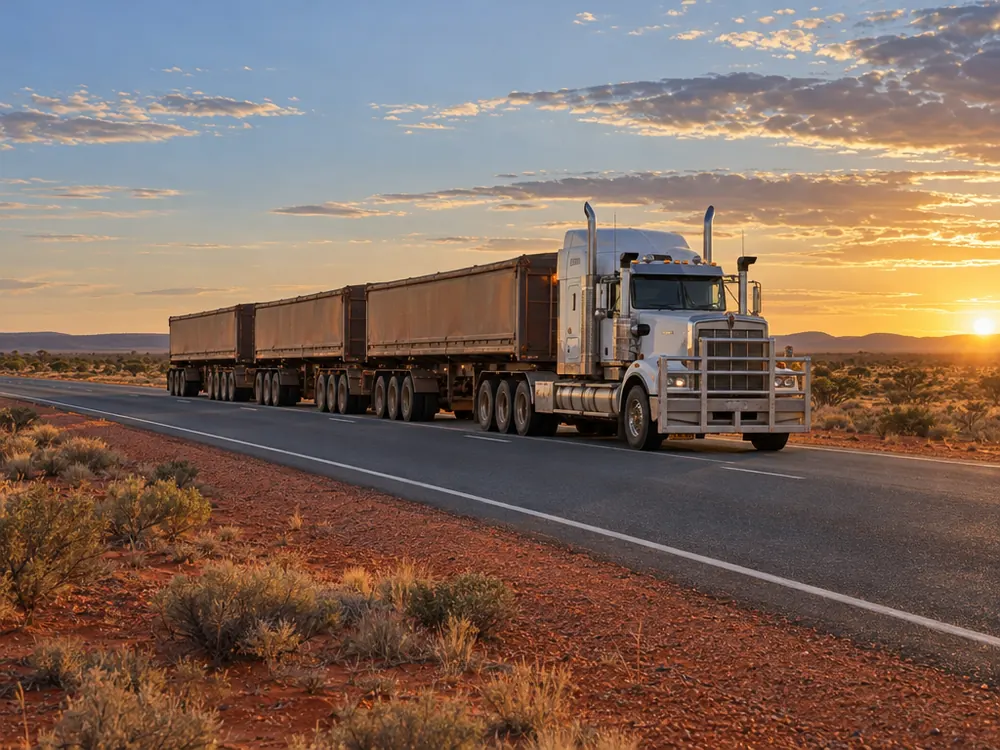
Road trains are now in. NHVR's mass and dimension page says it plainly: "Euro VI concessions have been expanded to include road trains."
For PBS road trains, PBS road trains can run as Euro VI vehicles from the HVNL implementation date without the Pavement Vehicle Loading Standard exemption. Earlier Vehicle Approvals that carried that exemption are treated as compliant.
What did not change is the road train steer allowance. A road train prime mover or hauling unit has a GML steer limit of 6.5t on tyres at least 295mm and 7.1t on tyres at least 375mm.
On a road train, the 7.1t steer allowance and the Euro VI 500kg do not stack: NHVR's PBS guidance says "7.6t on the steer is not possible".
Changed
- Euro VI concessions expanded to road trains
- PBS road trains can run as Euro VI without the Pavement Vehicle Loading Standard exemption
- Earlier Vehicle Approvals with that exemption treated as compliant
Still applies
- Road train steer 6.5t on tyres 295mm or wider, 7.1t on 375mm or wider
- 7.1t and the Euro VI 500kg do not stack ("7.6t on the steer is not possible")
- Manufacturer ratings cap the load
Sources: NHVR, mass and dimension, HVNL updates for the PBS scheme, general mass limits
The road train change arrived in the same package as the general mass increase. From 1 August 2026, General Mass Limits rose to match the former Concessional Mass Limits, CML and the 1-Tonne Tri-Axle Mass Transfer Allowance were removed, and tri-axle groups at GML get 21t. Our explainer on the 1 August HVNL changes covers the rest of that package.
What is still unsettled?
The legislation does not fully reflect the approved policy intent.
Source: NHVR, about the HVNL
NHVR's current position is that "the legislation does not fully reflect the approved policy intent" of the reform. It said the NTC is addressing this and that "amendments to the legislation are intended".
The policy intent itself is clear. The NTC confirmed that Euro VI vehicles may have up to 500kg extra mass across the steer and drive axles. That comes with a 315mm tyre on the steer axle if it is loaded over 6.5t, and no manufacturer ratings exceeded. In the meantime NHVR said it would "administer and enforce" in line with that intent, and it has updated its PBS Vehicle Approval processes.
So check before you rely on a figure. On 22 October 2026 NHVR said it is answering practical questions from operators on the reforms, with FAQs and factsheets on its HVNL reform implementation page. NHVR's mass exceptions page also points to its Euro VI information sheet for further reading. None of this replaces the truck's own ratings or advice on a specific vehicle.
The Euro VI figures in one view
- 6.5tSingle steertyres 295mm to under 315mm
- 7.0tSingle steertyres 315mm or wider
- 11.5tTwinsteer grouptyres 275mm or wider
- 44.5tVehicle not B-double or road train, complying steer axle
- 48.0tTwinsteer prime mover with tri-axle semitrailer
- 7.1tRoad train steertyres 375mm or wider, no Euro VI 500kg on top
Never above the manufacturer's ratings
Sources: NHVR, general mass limits, HVNL updates for the PBS scheme
Each figure here has a condition attached: a tyre width, a vehicle type or the manufacturer's ratings. Read the condition before the number.
What to ask your carrier or fleet manager
Sources: Department of Infrastructure, ADR 80/04 questions and answers; NHVR, HVNL updates for the PBS scheme, general mass limits, HVA scheme tiers
Mass is a shared duty along the supply chain. Our chain of responsibility explainer sets out what shippers and receivers owe. When a quote or fleet plan assumes Euro VI mass, these five questions get you to the facts:
- Is the truck ADR 80/04 or later? The Euro VI mass transfer allowance requires ADR 80/04 or later.
- What width are the steer tyres? Over 6.5t on a single steer needs tyres of at least 315mm, and over 11.0t on a twinsteer needs at least 275mm.
- What are the manufacturer ratings? GVM, GCM, ATM, tyres, axles and coupling all cap the load, whatever the legal limit says.
- Is it a PBS vehicle, and what does its Vehicle Approval say? Grandfathering and the tri-axle drive group rule both turn on the Vehicle Approval.
- Does the operation rely on accreditation? ACA-Mass is still required for certain notices and schemes, including Higher Mass Limits and some PBS combinations.
If a carrier quote or fleet plan has left you with a Euro VI or mass question this piece doesn't answer, send it to Logistics Industry News through our contact page.
Sources
- https://www.infrastructure.gov.au/infrastructure-transport-vehicles/vehicles/vehicle-safety-environment/questions-and-answers-new-adr-8004
- https://minister.infrastructure.gov.au/c-king/media-release/supporting-productivity-heavy-vehicles
- https://www.nhvr.gov.au/road-access/mass-and-dimension/mass-limits/mass-exceptions
- https://www.nhvr.gov.au/road-access/mass-and-dimension
- https://www.nhvr.gov.au/road-access/mass-and-dimension/mass-limits/general-mass-limits
- https://www.nhvr.gov.au/road-access/performance-based-standards/hvnl-updates-for-the-pbs-scheme
- https://www.nhvr.gov.au/about-us/hvnl
- https://www.nhvr.gov.au/news/2026/10/22/nhvr-tackles-key-industry-questions-arising-from-hvnl-reforms
- https://www.nhvr.gov.au/law-policies/hvnl-reform-implementation
- https://www.nhvr.gov.au/safety-accreditation-compliance/heavy-vehicle-accreditation-scheme/about-the-hva-scheme/hva-scheme-tiers